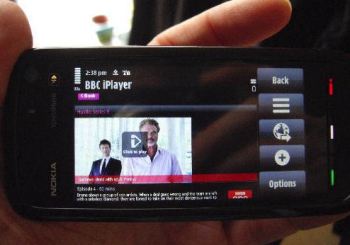
 The BBC’s fantastic iPlayer is getting more and more mobile use. When it was first introduced over five years ago, it was only ever intended for viewing on computers at home – even HD TV was far from a reality for the average user. However, nowadays its common to see someone watching the latest TV show or film using their mobile while on the bus. With the recent furore about the mobile data limits imposed by EE on their new 4G network, we thought we’d look into how far your bandwidth allowance will go when watching TV on BBC iPlayer.
There are lots of varying answers online as to how much of your mobile data allowance iPlayer will use up. A big problem with many of them is they are guesses or outdated. iPlayer has recently rolled out higher-quality streams that will use up more bandwidth. Another issue is that it’s quite hard to measure exactly how much data is actually being transferred by iPlayer as many users don’t;’ know how to isolate it and measure just that rather than all the other downloads and uploads going on with torrents, email, push notifications, HTTP requests and other protocols all running in the background.
We ran some simple tests on five different iPlayer programmes to see how much bandwidth it uses. We measured the total amount of data and came up with an average amount for an hour long programme.
The answer
On average, watching TV on iPlayer will use about 632MB/hour. It could be as low as 600MB/hour but it could also be much higher so, to be safe you should budget about 600-700MB for every hour that you are streaming.
How long will my allowance last?
With data allowances on most mobile phones being between 500MB and 1GB the simple table below will make it clear how much TV you can afford to watch each month before going over your limit. Don’t forget that the amounts below are if you only watch TV. If you use you mobile internet to download games or even check email and update Twitter, the amounts will be less (in some cases significantly so).
Many more details
The way that iPlayer works is incredibly complicated. There are a variety of audio and video codecs, you than access it on a huge array of platforms and there are simply hundreds of variables to consider. On top of this, calculating how big a certain piece of video will be when encoded and compressed on a computer is already an inexact science. If you just want to know roughly how much mobile data you’ll use watching TV on iPlayer, the figure above will do. But if you’re more interested, we’ll delve into the details a bit more.
Our calculations
To work out how much bandwidth it really uses, we took a sample of five different programmes that were recently broadcast on BBC channels. We tried to get a variety of different shows as the particular characteristics of each TV show will result in slightly different file sizes. We then shut down all web services apart from iPlayer and used a bandwidth monitoring programme to see how much data each programme took. We repeated the results later using the HD version of the streams.
Having done all this, we collated the results and, using the broadcast length of each show, calculated a bandwidth rate for each in MB per hour. So now the table below displays how much bandwidth each show will take per hour of streaming as well as the average.
| Programme |
Standard bandwidth (MB/hour) |
HD bandwidth (MB/hour) |
Later Live With Jools Holland
(Series 41 Episode 5) |
658 |
1110 |
Never Mind The Buzzcocks
(Series 26 Episode 5) |
630 |
1134 |
The Thick Of It
(Series 4 Episode 6) |
637 |
1024 |
Natural World
(Episode 3: Queen of Tigers) |
633 |
1126 |
Eastenders
(2012-10-25) |
600 |
1110 |
| Average |
632 |
1101 |
As you can see, watching the standard stream you’re looking at about 632MB/hour for streaming over iPlayer. This is quite high so definitely keep an eye out if you have any monthly bandwidth limit and especially if you tether your phone to stream TV using a PC or laptop.
The HD-quality stream may look fantastic but they use almost twice as much data. Our results showed that view HD material on BBC iPlayer uses about 1101MB/hour or almost 1.1GB/hour. With a 5GB limit you’ll run out of data just watching ten minutes of TV a day.
Other considerations
The original iPlayer app used a peer-to-peer protocol to distribute video. This meant that in addition to downloading the programme you were watching, you would also upload large amounts of data making the bandwidth required even larger. Sometimes uploads even continued after you stopped watching. However, this is no longer an issue. It is worth considering that iPlayer has recently upgraded to a higher quality data stream which means that the bandwidth required is greater and that old estimates are probably out of date.
Don’t forget that iPlayer also uses completely different audio and video codecs depending on the receiver you are using. They have various efficiencies and bandwidths too. The resolution also changes resulting in vastly different data usage amounts. So, for example the iPhone H.264 feeds from the BBC are higher quality than in the Flash-based in-browser iPlayer.
The stream quality and bandwidth required also depends on the network you use. So using a Nokia N95 to watch iPlayer over 3G will use less bandwidth than using Wifi while watching iPlayer through a Wii or iPhone will result in a limit on the resolution of the stream. The best way to watch it is with a PC (whether using wifi or tethered to your mobile phone) where you can choose the resolution, you get high-quality H.264 encoding and you can get resolutions up to 720p. This does mean that you need a lot more bandwidth though with data requirements coming in at up to about 1400MB/hour.
Conclusion
iPlayer uses a lot of bandwidth, especially if you want to view the lovely HD quality streams. We can predict roughly how much data it will take up but be sure to use an app to track your mobile internet usage if you want to be sure. And be aware of how much you’re using so if you don’t have unlimited data and need to keep within network limits, you don’t get hit by massive fees.
Continue Reading



Recent Comments