Google has just released the latest Android OS platform versions details. These data show what proportion of Android devices are running which version of Android. The results are quite promising for Google – over 10% of users have the latest version of Android (Jelly Bean version 4.1 or 4.2) on their phone or tablet.
The methodology used by Google was to collect data from Google Play users over the busy Christmas period between 21 December 2012 and 3 January 2013. From this information, they aim to help develops get a better idea of which versions their apps need to support.
We’ve included the data below so you can see for yourself. Each column is sortable by clicking on the arrows in the header.
| Version |
Codename |
API |
Distribution |
| 1.6 |
Donut |
4 |
0.2% |
| 2.1 |
Eclair |
7 |
2.4% |
| 2.2 |
Froyo |
8 |
9.0% |
| 2.3-2.3.2 |
Gingerbread |
9 |
0.2% |
| 2.3.3-2.3.7 |
Gingerbread |
10 |
47.4% |
| 3.1 |
Honeycomb |
12 |
0.4% |
| 3.2 |
Honeycomb |
13 |
1.1% |
| 4.0.3-4.0.4 |
Ice Cream Sandwich |
15 |
29.1% |
| 4.1 |
Jelly Bean |
16 |
9.0% |
| 4.2 |
Jelly Bean |
17 |
1.2% |
It’s easy to see that Gingerbread leads the way comfortably with almost 50% of devices using Android version 2.3.3-2.3.7. Next closest is Ice Cream Sandwich with a total of almost 30% of devices. Fragmentation of Android is not as bad as some would claim as early versions of Android such as the pre-Gingerbread Donut, Eclair and Froyo only just make up 10% between them.
Historical distribution and graphics
The follow graph (credit Google, edited for sensible date format) shows how quickly each subsequent version of Android has been adopted.
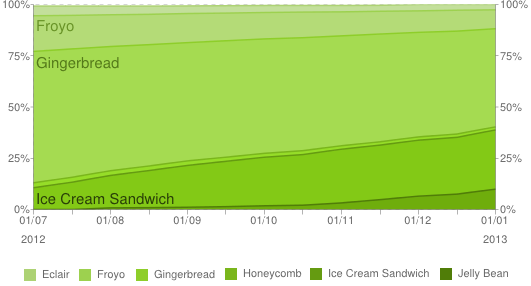
The graph is promising for Google as it shows that adoption of the new Jelly Bean version of Android is currently faster than what the previous version, Ice Cream Sandwich (ICS) managed when it was released. Although it has only been out for about half a year, Jelly Bean has already managed to get almost 10% of users. In comparison, Ice Cream Sandwich was only on about 7% after a longer period of time.
However, drawing conclusions is not quite as simple as raw statistics. It’s also important to consider how big a change each new version is – vastly different versions of software are often adopted slower as the task for manufacturers to port them to their hardware becomes more complex. The solid progress of Jelly bean might merely be attributed to the fact it consists only of relatively minor updates so more devices are viable and introducing the upgrade is relatively painless.
Furthermore, the progress hasn’t been so good everywhere. In the UK, TechCrunch are reporting that thousands of EE customers have still to get a Jelly bean update on the fantastic Samsung Galaxy SIII. This phone is more than capable of running the latest versions of Android so that’s not an issue at all and all the other networks have already rolled out Android 4.1.1 onto the Galaxy SIII. In fact, O2 and Three Mobile were very quick of the mark to push out the update. It’s not exactly clear why Orange and T-Mobile are dragging their heels but forums are filled with frustrated messages threatening to leave over the farcical delay. Still, overall amongst the majority of networks, Jelly Bean is being adopted very quickly.
Google also provide information about the most popular screen sizes for Android devices. Although this data is somewhat out of date due to being collected in October last year, in general, big screens haven’t caught on in a big way yet. The vast majority of screens are, as Google defines them, “normal”. Barely 6% of devices have large screen and less than 5% boast xlarge screens – in total this is barely 10% of devices with almost all of the remainder on normal-sized screens.
Pixel density has also been measured by Google. They report that over half of all devices now have high pixel density which almost 30% now are running extra high pixel density. Small screens with low pixel density now make up just only less than 2% of Android devices.
On graphical performance, Google also report than nowadays almost all smartphones have support for OpenGL ES 2.0. Over 90% of devices have it meaning that less than a tenth of Android users are stuck with just support for OpenGL ES version 1.1.
What do you think of these stats? Are you on Android Jelly Bean yet? If so, what do you think of it and how quickly were you upgraded? And can anyone guess what the next version of Android is going to be codenamed?
Continue Reading
 Serial entrepreneur Dan Lane has sadly announced that his project


Recent Comments