No longer a teen: txt trns 20
Text messaging is all grown up! This month, SMS text messaging turns 20. It’s hard to remember a world without mobile text messaging any more, but the first text was sent only back in 1992. Neil Papworth sent an early Christmas text to Richard Jarvis, a Technical Director of Vodafone on the 3rd December.
Of course, text messaging didn’t become popular in the mainstream for several years after that. For one thing, mobile phones weren’t yet capable of even sending texts, only receiving them. Still, texting, properly called Short Message Service or SMS for short(!), is responsible for a lot over the years. Nowadays we have the advent of sexting but no doubt SMS has saved many lives and ended many relationships. Today there are an astounding 3.6 billion users.
The invention of the text
The idea of adding textual messaging features to mobile phones was first conceived in the early 1980s. It was quite a technical achievement to work out how to send textual data over a network optimised for voice calls. In the end, it was worked out that texts could be transmitted by utilising the same signalling paths used to control voice traffic when they were not in use.
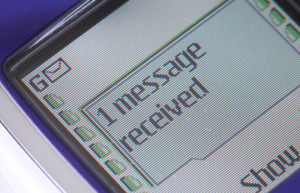 The early development was carried out in the early GSM organisation pioneered in France and Germany. Early proposals revolved around setting a global standard so that all international networks could use the same technology. The initial proposals were approved by the GSM group by 1985.
The first texts
Neil Papworth’s first-ever text was pretty swiftly followed by commercial implementations. Sweden was the first couple to get a Short Message Service Centre allowing the sending and receiving of text messages and it was swiftly followed by BT Cellnet (O2) in 1993. Nokia was a pioneer in producing mobile phones capable of sending text messages as well as receiving them.
At first, texting took a while to catch on. In 1995 the average customer sent a text message less frequently than once every 2 months. This wasn’t helped by the fact it took until 1999 for UK networks to allow users to send texts to people on other networks. However, by the end of the next year, texting had exploded. The average number texts per customer was now more than 1 every day and over 200 million SMS messages were sent in the UK on one day in 2006.
Technicalities and growth
Around the rest of the world, texting continued to grow in popularity. It had already grown from 17 billion to 250 billion in the year up to 2001. The next milestone was the 1 trillion mark which was hit back in 2005. The same year, SMS texting was worth about £50 billion. That’s more than the entire GDP of Croatia!
 The US did lag behind a lot. In 2005 there were fewer than 10 billion texts sent per month. However, they soon caught up with the rest of the world and by 2008 that figure had multiplied many times – there were about 840 billion texts sent over the year.
One curiosity about texting is the character limit. This is a technical limitation that originates from the first genesis of SMS. Originally messages were limited to 128 bytes with each byte encoding one character. Later on, this was increased to 140 bytes meaning that each text could have 140 characters in it. The restriction, combined with awkward numerical keypads, led to ever more creative ways to fit information into the low character limit. Soon “txt speak” was born and school children soon gained expertise in writing in this dialect quickly and deciphering the 21st century shorthand.
How then did we get to 160 characters today? Well, they stripped some of the possible characters out meaning that it then only required 7 bits to encode each character. This is opposed to the 8 bits required normally. As 140 bytes is equal to 1120 bits, that allows for exactly 160 characters.
Another advance has been the ability to concatenate multi-part messages. So now it’s easy to send long messages spread over several SMS texts. They are automatically joined when received.
Nowadays texts are a firm part of modern day life. Ofcom claims that SMS is the most common method of communication. We’re more likely to text family and friends on a daily basis than get in touch by any other means. And almost 60% of UK adults text at least once a day. (As an aside, check out this amazing research that shows how hackers can read your texts and passwords by reconstructing your smartphone keypresses from reflections in your glasses).
Do you remember when you sent your first text? How has your text message usage changed over the years? How many texts do you send a month now? And do you see a future for SMS text messaging in the age of the smartphone and unlimited data?
 We’ve just published out newest mobile phone network review:
  The police department from a small town called Mildura posted an


Recent Comments