04 December 2013 ~ 0 Comments

Has the iPhone 5C tanked?
iphone 5c

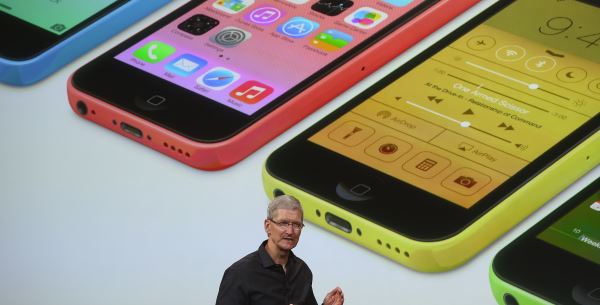
It’s been a few months since Apple’s release of its new mobile phones, the flagship iPhone 5S and the “budget” option, the iPhone 5C. It’s fair to say that the sales figures have been very impressive – within just days of the launch in September, Apple had shifted almost ten million iPhones making it a new sales record for the Cupertino company.

However, industry analysts have not failed to notice that Apple did not reveal the split in sales between the two devices. And, in actual fact, it turns out that there’s a fairly significant difference. The actual disparity is far bigger than most people were previously predicting.

We’ve seen the latest report from Kantar Worldpanel ComTech which suggests that the more expensive iPhone 5S is outselling the 5C by a threefold factor. Kantar Worldpanel is a well-established market research company that has been headquartered in London since 1997. Their latest research report looked at data from UK sales up until the end of October.

Following the initial announcement announcement of the phone, the lacklustre specs of the 5C combined with the relatively high price led many to predict it would suffer from poor sales. However, almost no one expected the discrepancy to be quite so significant.

It is tempting to see the relatively poor sales of the iPhone 5C to be a failure. After all, Apple has been dogged by reports that have been artificially-constricting the supply of the 5S in order to try and shift more units of the less desirable 5C. Factually, it is certainly the case that the 5S has been barely able to keep up with demand. And it has also been reported that Apple’s Chinese factories are shifting production away from the 5C to produce five best handsets at a faster rate.

However, despite having a much higher price then almost any other handset on the market, evidence does suggest that the iPhone 5C is making some inroads into its target market of poorer households, especially in richer Western nations. Twice the proportion of iPhone 5C owners have lower incomes when compared to owners of the iPhone 5S.

Most encouraging for Apple is the fact that the 5C is drawing customers away from their big rivals; Samsung in particular. While the vast majority of iPhone 5S owners were already Apple converts and had upgraded from a previous iteration of the iOS smartphone, the iPhone 5C seems to be winning over new customers with about 50% of the buyers coming from competing brands. Certainly its lower price point has a huge part to play in that.

One mustn’t be too hasty to declare the 5C success, though. Arguably the cost is out of reach of the majority of consumers and, despite an aggressive marketing campaign, only older and cheaper models of the iPhone have any chance of making substantial inroads into emerging markets around the world.

Indeed, Apple’s market share overall is still in decline. So while the iPhone is shifting boxes at a frenetic pace, Android and Windows Phone are taking ever-increasing bites out of Apple’s share of the smartphone market. In fact, the latest figures show that Google’s Android is by far the most popular mobile platform in Britain largely due to the widescale availability of lower-priced handsets running the operating system.

With the entrance of cut-price Chinese manufacturers such as Lenovo, Zopo and Star into European markets, we predict that this trend will only continue into 2014. It’s likely that android we running on more and more people’s phones over the coming few years especially if Apple refuses to be competitive in the lower income price ranges.

Smartphones are now truly mass-market devices – almost every new mobile phone sold nowadays in Britain is a touchscreen smartphone. Already, Android is on more than seven out of every ten mobile phones in Europe and dominates more than half the market in the UK. Meanwhile, Apple’s lingering behind but less than 30% of the market and BlackBerry has been almost entirely squeezed out with less than 3% according to the latest figures and this year.

So, what you make of these figures and the report that the iPhone 5S is outselling the iPhone 5C by three to one? Does this latest new surprise you at all or is it what you’ve come to expect from the latest iPhone launch? And how do you see the battle between Google’s Android and Apple’s iOS continuing over the course of next year? Please let us know your thoughts and opinions in the comments below.
Continue Reading

26 November 2013 ~ 0 Comments

BlackBerry’s new UK MD

alexandra-zagury-md

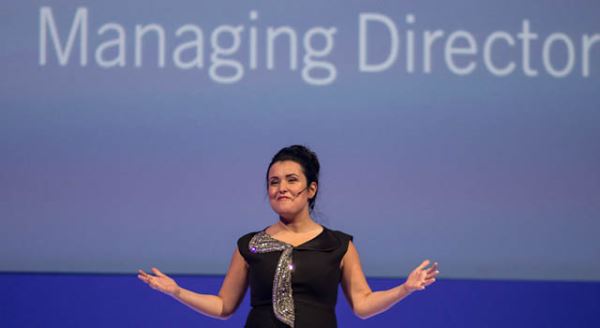
Alexandra Zagury has been named as the new managing director of the UK and Ireland branch of BlackBerry, formerly known as Research In Motion (RIM). Struggling smartphone manufacturer is made the move following Rob Orr’s defection to up-and-coming rival Samsung back in June.

In the meantime, the MD or the whole Europe, the Middle East and Africa (EMEA) region, Robert Bose, had been taking on the job an interim basis. There has been a lot of speculation that Zagury would takeover but it has only recently been confirmed that she will step into the position. Replacing Zagury in her previous post will be former Yudi Moodley who was previously the business management director for the Middle East and Africa.

Alexandra Zagury is a graduate of the London School of Economics in London and has been with the company for several years now. Ahe spent much of that time – total of about 18 months – working as a director for the South Africa, Southern Africa of BlackBerry.

During this period, she relocated to BlackBerry’s offices in Johannesburg. She is also hold a position as the MD of the Turkey branch in Istanbul as well as working in many senior roles for BlackBerry in the UK.

Despite her wealth of experience, there is no doubt at all at that her job will be a very tough one as she desperately aims to alter the fortunes of struggling BlackBerry. In recent years, and especially following the tough competition from Apple and Google, profits are income have been falling at BlackBerry and there’s little doubt in industry that the BlackBerry 10 platform has been all but a failure according to adoption figures.

Dispute this, Alexandra Zagury has strongly suggested that the BlackBerry 10 platform – running on QNX – is obsolete positions allow BlackBerry to lead the way mobile phones to mobile computers. She has claimed that the experience offered by this operating system means that user experience will not be, might as phones become more and more powerful.

Alexandra Zagury will also be aware that the UK market is much more competitive and a tougher nut to crack than Africa. She recently tweeted that BlackBerry drives 14% of Internet traffic in Africa but this is mainly due to the fact that older BlackBerry devices are available for much lower cost and the latest android and Apple smart phones. It’s also not certain whether they’ll be to keep up this trend as smart phone manufacturers target developing regions with cut-price android offerings.

It is also telling that, despite BlackBerry accounting for 14% of aggregate Internet traffic in Africa, major competitors to is BBM messaging platform such as what’s up and Skype are fast rising rivals. Dated protocol WAP is also third in the list behind BlackBerry suggesting that when high-speed mobile Internet becomes more common, the more traditional offerings allowing smart phones to connect a regular mobile networks will become more popular as they have done in more established markets. Mobile Internet access is still rather in its infancy in Africa and as it matures, BlackBerry will have a tough time trying to hold onto its portion.

What you make of this news? Does Alexandra Zagury have what it takes to turn around BlackBerry’s fortunes in the UK market? Or is it simply too late for the struggling company already? Please let us know your thoughts and opinions.

Continue Reading

21 November 2013 ~ 1 Comment

App Review: SwiftKey

Welcome to our first app review. Today we’re going to be looking at the latest version of SwiftKey, a replacement keyboard for Android smartphones.

SwiftKey has been out in the Play Store for a few years now and we been using it as our main keyboard was long as we can remember now. It has tens of millions of installs on phones worldwide and has made the top apps list in over 58 countries. It’s been described as a “creepy-fast typing experience” but how have we been getting on with using it?

After you install the app, SwiftKey allows you to select your language and then instructs you how to set it as the default keyboard so you can use it it all text entry areas within Android. This means you can use it for everything including e-mails, texts, calendars and even instant messaging programs. Having this consistency across the entire user experience some of the great benefits of the Android.

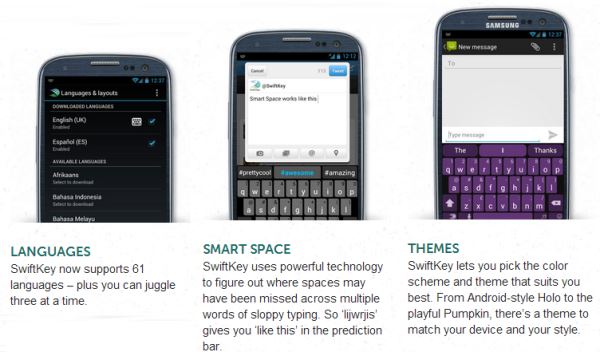
The actual appearance of SwiftKey is fairly minimal – it’s smart and professional but not all that different from the normal keyboard. There are various customisation options including the size of the keys and also colourful themes to choose from if you so desire. One thing you will notice is the very prominent suggestions bar above the keyboard that is always present even if you haven’t started typing yet. This demonstrates the importance of SwiftKey’s signature feature – shockingly-intelligent auto-prediction.

swiftkey 1

The developers have studied natural language extensively to work out what words are likely to follow others depending on the particular lexicon, grammatical rules and the type of vocabulary you usually use. So, for example, if you have already typed “the dog went to fetch” the next two suggested words would be “the” and “a” and if you type in “the” it might suggest something like “stick” next.

Even better, you can allow SwiftKey to analyse your text messages and e-mails to better understand the style of writing you have and so it can customise its predictions just for you. In this way, it learns words that you use commonly as well as the way you use them to form sentences. It combines this with really great automatic correction of typos and mispresses. Together, we find that this means you can usually type away at a pretty frenetic pace without worrying about making manual corrections and changes along the way.

In fact, while using it we found that we could frequently walk down the street taxing away without even having to glance down at the screen because SwiftKey would make allowances for any typos and inaccuracies from not paying attention to the screen. It makes on-screen keyboards a bit less of a pain to use and really makes for far fewer moments when you’re frustrated as you feel you’re being slowed down by your input device.

swiftkey 221

Of course SwiftKey can’t compete with a full-size physical keyboard, but we found it gets pretty darn close. We would even frequently find ourselves wishing that our computer had the sort prediction capabilities that SwiftKey offers to make typing that much faster.

Naturally, it’s not entirely perfect. Before you have trained it up much, you might find that there are many words missing from the dictionary and it sometimes makes some odd suggestions. Also, the suggestions sometimes move position just before you have a chance to click on them meaning that you occasionally insert the wrong word by accident. However, overall, occurrences like this are pretty rare and it must be said that it’s a massive improvement on any other keyboard we’ve used.

Some other great things we like about SwiftKey is the ability to have multiple languages. This is great if you are a polyglot and frequently need to write in multiple languages. It also activates up to three languages simultaneously so you don’t have to toggle back and forth – great if you simultaneously and find yourself code switching mid-sentence.

SwiftKey also has the best numberpad and symbol layout we’ve seen in any smartphone keyboard. It even gives you quick access to the symbols through long-presses on the keys and even has the option to select accented characters and diacritical marks by the same mechanism.

Finally, SwiftKey copied the Swype method of sliding across the keyboard to enter words. While it takes some getting used to, it turns out to be surprisingly quick and accurate. We still find it to be somewhat slower than using SwiftKey’s default auto-suggestion feature, but if you are a fan of this style you’ll be happy to know that is supported. There are also some advanced customisation options and different layouts available for larger screens and tablets.

On just one of our phones, the statistics that SwiftKey records show that it has saved almost 60,000 keystrokes already as well as corrected about 20,000 typos. Overall, we’ve made full use of the auto completion function as the software has completed words for us halfway through about 10,000 times. We don’t make use of the flow feature as we find it to be a little bit slower, but SwiftKey estimates that the net increase in typing efficiency has been over a third overall which is pretty substantial if you think about it.

swiftkey logo

SwiftKey is available for a free trial in the Play Store but it’s only a few quid if you want to buy the full version and we would highly recommend that. While Google’s default Android keyboard has been steadily borrowing its features and has dramatically improved in recent iterations, SwiftKey still has significant advantages over other keyboards. We certainly couldn’t go back to using anything else.

Continue Reading